
By Sameera Rafiq, Communications & Outreach Manager, NAPIC; Sonalika Jain, Technology & Innovation Manager, NAPIC; Imran Afzal, CEO, NAPIC; and Derek Stewart, Co-Director, PRODUCE Pillar, NAPIC; James Hutton Institute

Future Food-Tech London 2026 brought together over 550 attendees from 45 countries, with 98 speakers and 38 exhibitors spanning food brands, ingredient companies, start-ups, investors, researchers and regulators.
The overarching message: the conversation has shifted from proving alternative proteins can work to building the infrastructure, partnerships, evidence and confidence needed to scale them. Alternative proteins are no longer a niche on the edge of the food industry. They are becoming part of how the whole industry plans to innovate and provide for a growing population.
Four themes came up again and again, with collaboration running through all of them.
Theme 1 of 4
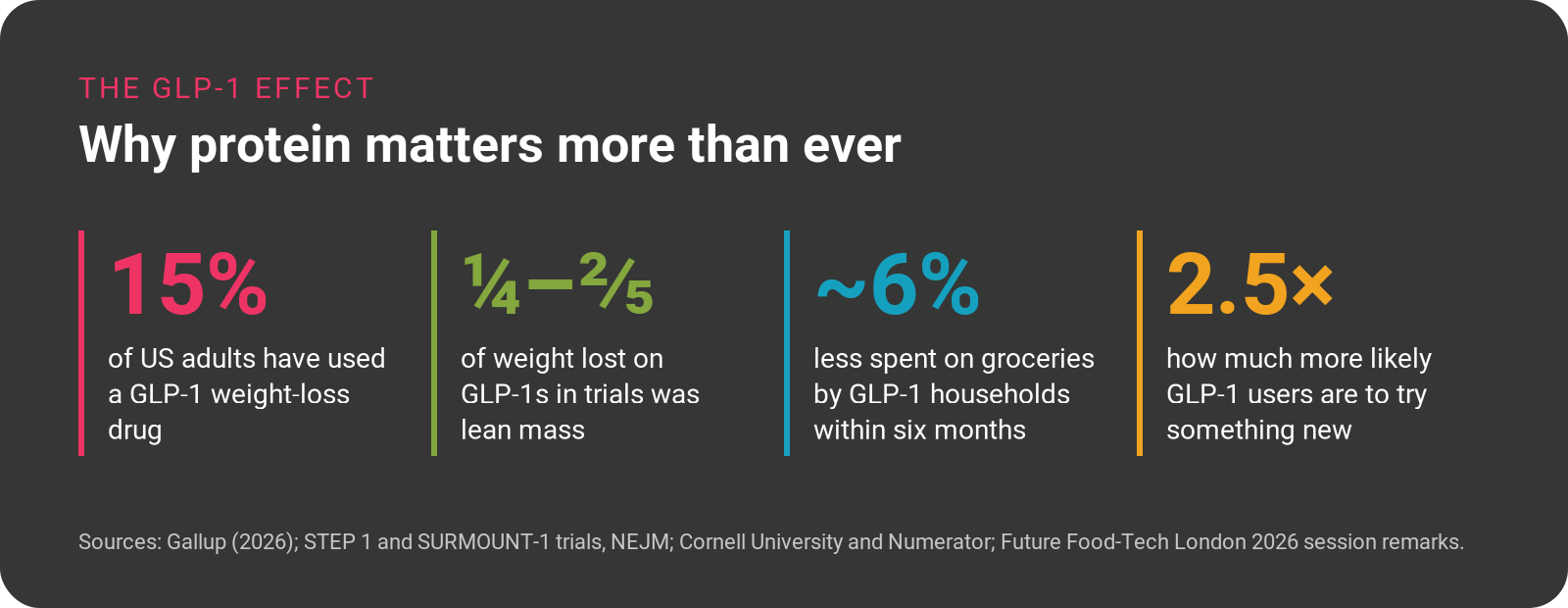
Demand for satiety, protein density and better nutrition is rising fast, driven by GLP-1 and the push for healthier baskets. New protein sources, and foods that incorporate more protein or are simply more nutritious, are well placed to meet it.
In the US, the share of adults who have ever used a GLP-1 weight-loss drug has reached 15% in 2026. Users lose muscle mass as well as fat (in trials, lean mass made up roughly a quarter to two-fifths of weight lost), so high-quality protein matters more than ever, and with semaglutide patents already expiring in key markets such as Canada, India, China and Brazil, access is set to widen.
One Cornell University and Numerator study found households with a GLP-1 user cut general grocery spending by around 6% within six months. Speakers said GLP-1 users are 2.5 times more likely to try something new, and well over half would pay more for healthier products that support their health goals. Panellists stressed that this is accelerating a wider shift: soon everyone will want healthier, more nutrient-dense food that still tastes great.
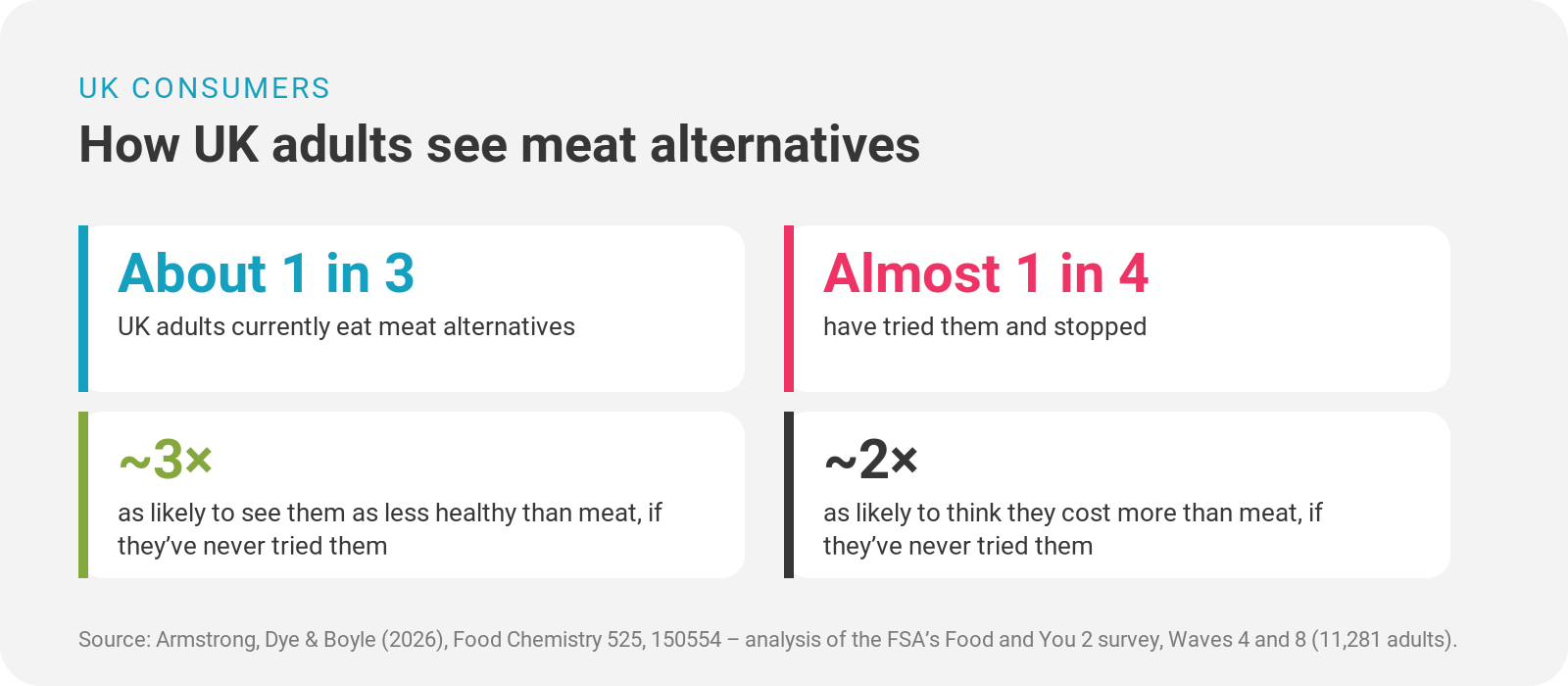
The food that wins is food people love and come back to. Alternative proteins that lead with taste and texture are the ones that will have a direct route to repeat purchases and everyday plates. NAPIC-affiliated analysis of the FSA’s Food and You 2 survey (2021–2024) found that while around a third of UK adults currently eat meat alternatives, almost a quarter have tried them and stopped, clearly pointing to the need for an improved consumer experience.
Theme 2 of 4
Speakers championed the idea that every side stream is a valuable resource waiting to be valorised into food. Alchemist, the Michelin-starred gastronomic restaurant in Denmark, spotlighted its rapeseed press cake: usually only the oil is extracted and the rest is wasted, yet the cake is high in protein and could become a sustainable protein ingredient.
NAPIC-funded work such as the Provale project, recovering protein from Scotch whisky pot ale with the James Hutton Institute and Arbikie Distillery, shows this in action. The next challenge is consistency: turning variable side streams into safe, standardised, food-grade ingredients at a price that works.
NAPIC-funded project
Provale
Recovering protein from Scotch whisky pot ale, a by-product currently used only as low-value fertiliser or livestock feed.
The James Hutton Institute and Arbikie Distillery
Precision fermentation and novel ingredients were discussed as commercial realities, with investors, regulators and global ingredient companies all in the conversation. The bioprocessing panel’s advice was practical: start-ups should commercialise first in easier-to-enter markets such as pet food and cosmetics to gain experience at scale and keep the business going, before moving into human food, which is a longer, harder and more regulated route.
UK start-up and NAPIC partner Meatly followed this logic, becoming the first company in the world to sell cultivated meat as pet food in 2025. NAPIC funded research with the University of Leeds and Wyldlife Nutrition to build the first digestibility evidence base for fermentation-derived cat food, which is helping more companies take this route.
NAPIC-funded project
Alternative protein innovation for cats
Building the first digestibility evidence base for fermentation-derived cat food.
University of Leeds and Wyldlife Nutrition
The prize is not only replacing animal protein but making everyday foods more nutritious: protein-enriched staples and blended products that get more vegetables, pulses and novel proteins into familiar recipes. Retailers are increasingly looking out for such products to place on their shelves and see in consumers’ baskets. Lidl has recently been paving the way in this area, launching a new high-protein hybrid meat range combining British meat with pea protein.
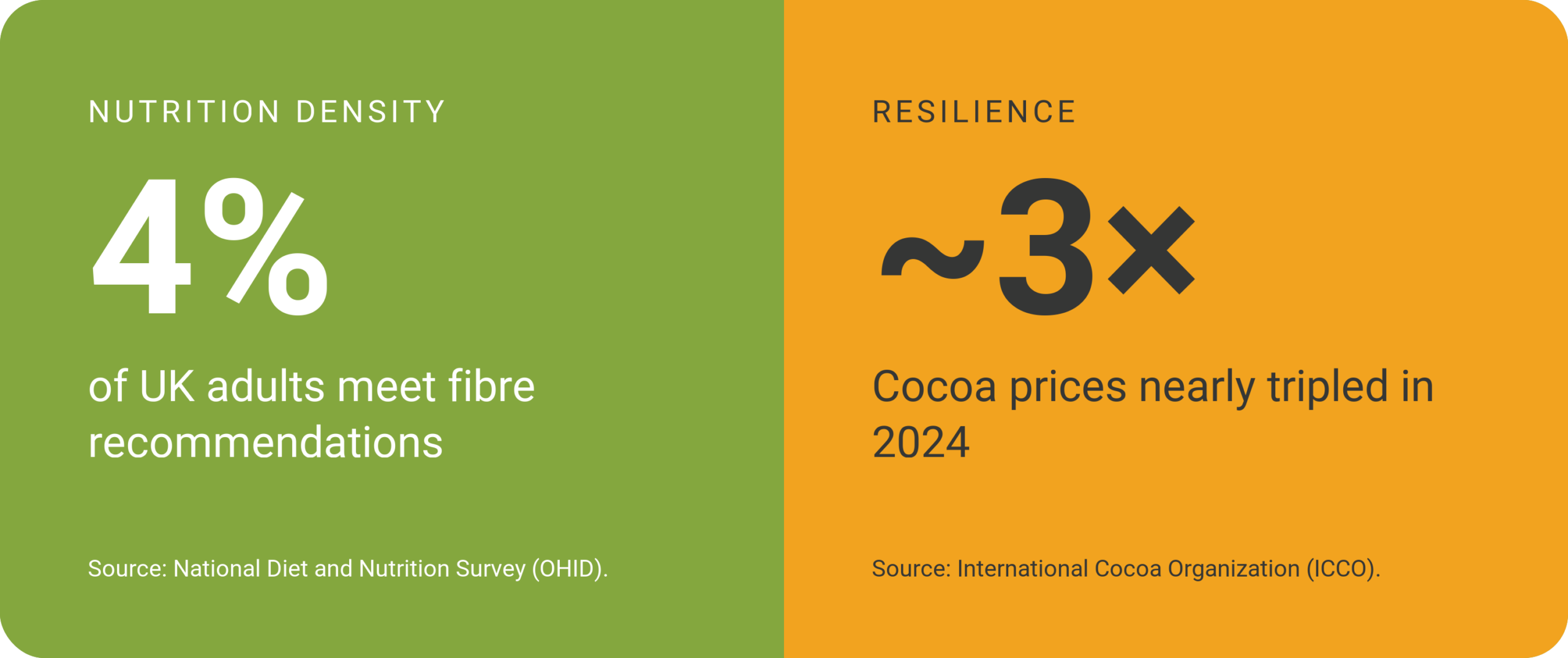
The opportunity is real – only 4% of UK adults meet fibre recommendations – but perception lags behind: people who have never tried meat alternatives are almost three times as likely to see them as less healthy than meat. NAPIC-funded collaborative projects are already testing this, from an additive-free, higher-protein vegan cheese with The Good Pulse Company to plant-protein-fortified chocolate co-sponsored by Nestlé.
NAPIC-funded project
Fermentation-enhanced pulse ingredients for vegan cheese
An additive-free, cheddar-style vegan cheese with more protein and less saturated fat.
University of Nottingham and The Good Pulse Company
NAPIC-funded project
Procolate
Plant-protein-fortified chocolate that keeps its taste and texture.
University of Leeds, co-sponsored by Nestlé
Climate change and geopolitical conflict are testing supply chains. Cocoa prices nearly tripled in 2024 and have since stayed relatively high, and the sunflower oil shortage, which continues to tighten local supply, forced brands to reformulate fast. PepsiCo, Unilever, OFI, Mars and Cargill all talked about diversifying ingredients, which makes alternative proteins a food security story as well as a sustainability one.
Theme 3 of 4
Moving great lab innovations into commercial markets requires aligning research, industry, regulation and consumers: a complex systemic challenge, and a defining opportunity for the UK to lead.
Founders are not short of ideas; they need pilot facilities, regulatory guidance, research partners and industry customers willing to co-develop. On the main stage, NAPIC CEO Imran Afzal set out what they need most: the right information at the right time, access to infrastructure, and milestone funding that lets them focus on their business instead of chasing the next round. As the panel put it, founders are not on this journey alone. 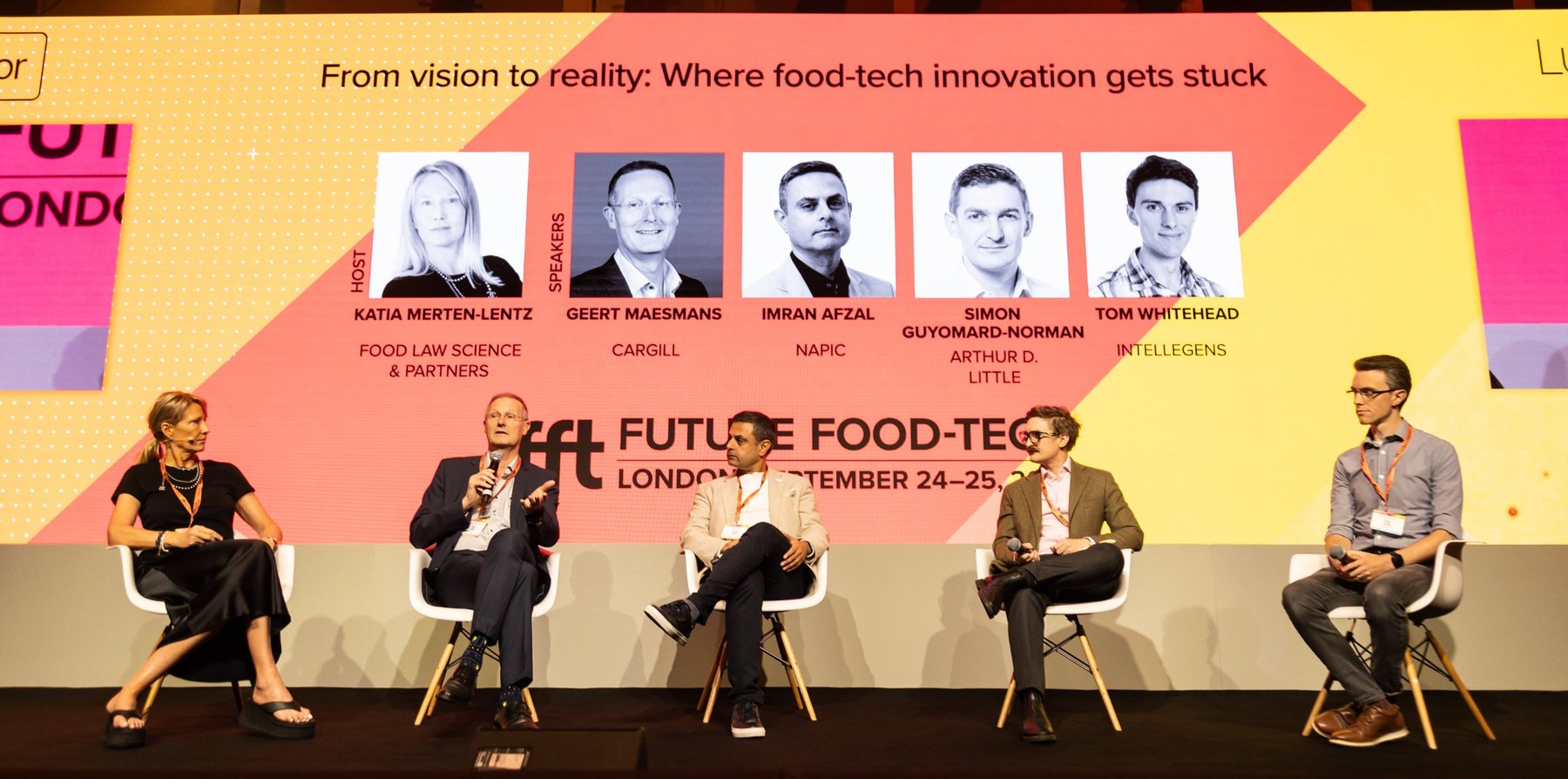
“It shouldn’t be seen as a valley of death, rather as a journey.”
“From vision to reality: Where food-tech innovation gets stuck” panel, Future Food-Tech London 2026
The companies that stand out will show a credible path to cost parity and make smart use of existing capacity, rather than building their own. That is why mapping and opening up access to scale-up infrastructure matters so much. Ecosystems that provide this will attract the companies, talent and investment that follow.
Innovating with scale in mind
These lessons come from the “Innovating with scale in mind” panel, where Sonalika Jain, NAPIC’s Technology & Innovation Manager, spoke alongside industry colleagues.

Theme 4 of 4
Future Food-Tech brought together stakeholders from across the globe, from retailers and global ingredient leaders to technology providers, innovators and investors, all talking about better nutrition and more sustainable ingredients. National and regional bodies were also present, including the Canadian Food Innovation Network, Future Food from Finland, the Region of Ghent and EIT Food, amongst others.
Consumers still tend to see healthy shopping as expensive, complex and not for them, yet as shoppers become more informed, significant growth in healthy sales is expected in the next few years. “Healthy” can feel exclusive, so the retailer talks about “healthier” and about taking shoppers on a step-by-step journey. Affordability is determined by everything in the supply chain before a product reaches the retailer, which makes it as much a challenge for ingredient makers and processors as for supermarkets.
Perception matters as much as price: NAPIC research found people who have never tried meat alternatives are about twice as likely to think they cost more than meat, while those who have tried them are not, suggesting price perception, rather than affordability, is the barrier. Ahold Delhaize has been running test-and-learns on “healthy checkouts”, and blended proteins that get more vegetables into familiar products are one practical bridge.
NAPIC-supported work with partners such as McDonald’s and Nestlé is aimed at exactly this consumer-side challenge. For example, the University of Sheffield and McDonald’s are studying how framings such as “cellular agriculture” versus “sustainable protein” affect people’s willingness to try alternative proteins, with findings shared openly, while the University of Leeds and Nestlé are showing that plant protein can be added to chocolate without compromising taste or texture.
NAPIC-funded project
Cellular agriculture vs. sustainable protein
How different framings affect people’s willingness to try alternative proteins, with findings shared openly.
University of Sheffield and McDonald’s
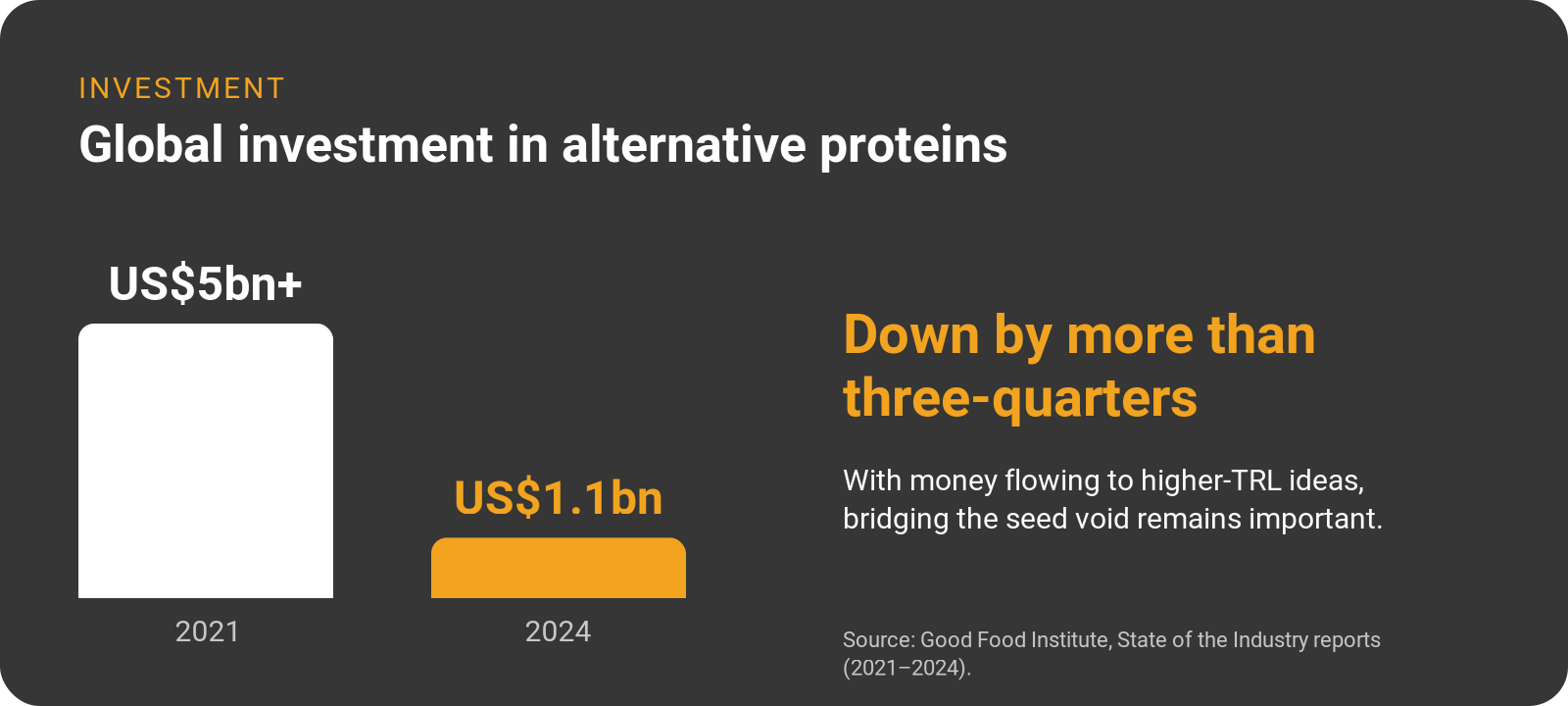
B2B models have a higher success rate than building whole new products and brands. Investors emphasised mobilising capital from corporates, seeing greater corporate involvement as an essential next phase in moving alternative proteins from niche tech experiments into mainstream commercial reality. With investment flowing increasingly towards higher-TRL ideas with greater confidence, bridging the seed void remains important. According to the Good Food Institute (GFI), global investment in alternative proteins fell to around US$1.1bn in 2024, from more than US$5bn in 2021.
Process changes can stop the Novel Foods clock, so early, commercial-scale safety data matters. In the UK, the FSA and FSS Cell-Cultivated Products sandbox, which NAPIC is involved in, is a government-funded programme running to early 2027 that brings regulators and industry together and has been publishing practical guidance for applicants.
The EU-UK Sanitary & Phytosanitary (SPS) Agreement negotiations are ongoing, with a decision on dynamic alignment expected in November, which will define whether the UK adopts the EU’s Novel Foods regulatory framework or secures ‘carve-outs’ and ‘exceptions’ within certain categories. NAPIC-funded research is feeding into this: Imperial College London and the FSA are testing whether existing hygiene inspection frameworks fit new production technologies, and the University of Sheffield is mapping policy and public-understanding gaps on cell-cultivated and precision fermentation proteins with the FSA, Food Standards Scotland and Ipsos.
NAPIC-funded project
Inspection and compliance frameworks for innovative foods
Testing whether existing hygiene inspection frameworks fit new production technologies.
Imperial College London and the Food Standards Agency
NAPIC-funded project
Mind the Gap
Mapping UK policy and public-understanding gaps on cell-cultivated and precision fermentation proteins.
University of Sheffield with the FSA, Food Standards Scotland and Ipsos
The message from Future Food-Tech is clear: the opportunity in alternative proteins is here, and the UK is ready to lead. Collaboration came up in almost every session. Innovation needs people working together, and that is what drives speed. The UK has the infrastructure, but innovators need help finding it, paying for it and connecting the dots.
NAPIC is built to turn this momentum into impact for the UK. Through Collaborative Programme Funding, we are bringing researchers and industry together on the projects that move alternative proteins closer to market. We are answering the most common question, “Where can I go to scale up?”, by mapping the infrastructure and physical facilities available in the UK and how to access them – making it one step easier for innovators to embark on the scale-up journey. We’re training up the next generation of entrepreneurs to take innovation to commercial reality.
No single technology will win, and people buy on taste and price. That is why NAPIC’s portfolio spans plant-based, precision fermentation, cultivated meat and other protein technologies across a range of technology readiness levels – giving consumers more choice and the sector healthy competition.
Join NAPIC
At NAPIC, we are working across the ecosystem with a vision to make alternative proteins mainstream for a sustainable planet. Become a member today to connect with researchers, industry, investors and regulators, and get access to the right expertise and infrastructure at the right time.